
How to Use Essential Oils: Diffusing, Topical, Inhalation and More
Every method explained, with the amounts that actually work.
You bought the oils. The bottles are lined up on the shelf. Now what? Learning how to use essential oils is the step nobody explains.
In fact, that is the moment most people get stuck. Knowing how to use essential oils is a separate skill from knowing what they do. The wrong method wastes oil, and the wrong amount can irritate skin.
This guide walks through every method, from diffusing to roll-ons. For each one, you get the exact amounts, the timing, and the mistakes to avoid. So you can start today, safely.
Before You Use Essential Oils: Three Rules for Every Method
Whatever method you pick, these three rules for how to use essential oils hold. In short, they keep the practice safe.
- Dilute before skin contact. Neat oil on skin can cause a rash, and over time it can make you react to that oil for life. Our essential oil dilution guide gives exact ratios.
- Less is more. As the Tisserand Institute puts it, raising the amount always raises the risk, yet it may not raise the benefit.
- Never swallow essential oils. They are not food. Any internal use belongs with a qualified clinician.
Also, buy oils you can trust. A poor oil will not work well by any method. If you are unsure about quality, read our guide on how to tell if an essential oil is therapeutic grade first.
How to Use Essential Oils: The Six Main Methods
Almost every answer to how to use essential oils is one of the six methods below. Learn these, and you can handle any recipe you come across.
1. Diffusing
To begin with, a diffuser spreads a fine mist of oil and water into the air. It is the easiest way to scent a room, lift a mood, or set up a calm bedtime routine.
Here is what works:
- Use 3 to 5 drops in a standard 100 ml diffuser. Larger rooms may take up to 8.
- Run it for 30 to 60 minutes, then rest for an hour. Do not leave it on all day.
- Keep the room aired. Constant heavy scent can bring on a headache.
- Clean the diffuser weekly. Old oil residue turns rancid and spoils new blends.
For sleep, diffuse lavender in the bedroom about thirty minutes before bed, then switch it off. Our post on the best essential oils for sleep covers the best oils for that job. For seasonal blends, see our summer diffuser oils.
2. Direct Inhalation
By contrast, this is the fastest method of all, and it needs no equipment. Hold the open bottle a few centimetres from your nose and breathe slowly for a minute.
Alternatively, put one or two drops on a tissue or cotton pad. Keep it in your pocket, or tuck it into your pillowcase. Personal inhaler sticks work the same way, and they last for weeks.
Direct inhalation suits focus at your desk, a quick calm before a meeting, or clearing a stuffy head on the go.
3. Topical Use (Massage, Roll-Ons and Skin Care)
Topical use means applying the oil to skin. This is where dilution matters most, because the oil stays in contact for hours.
The standard adult dilution is 2 percent. That is about 12 drops in 30 ml of a carrier oil such as jojoba, sweet almond or fractionated coconut. For the face, drop to 1 percent or lower.
A 10 ml roller bottle is the easiest way to keep a blend ready. Fill it with carrier oil, then add 2 drops for 1 percent or 4 drops for 2 percent. Roll it on pulse points, the back of the neck, or wherever the blend is meant to work.
You can browse our cold-pressed carrier oils range for suitable bases, and our post on best carrier oils for skin matches them to skin types. Always patch test a new blend on the inner forearm first, and wait a day.
4. Steam Inhalation
Meanwhile, steam is the classic method for a blocked nose or a chesty feeling. It is simple, and it works fast.
- Pour just-boiled water into a bowl and let it cool for a minute.
- Add 2 to 3 drops of eucalyptus, peppermint or tea tree.
- Drape a towel over your head and the bowl.
- Close your eyes and breathe slowly for 5 to 10 minutes.
Keep your eyes closed during steam inhalation. The vapour stings. Also, do not use eucalyptus or peppermint steam with young children. Their airways can react to menthol and 1,8-cineole. See our essential oil safety guide for age guidance.
5. Bath
A scented bath sounds relaxing. However, there is a catch most people miss. Essential oils do not mix with water. Drop them straight into the tub and they float on top, and you sit on neat oil.
So always mix the oil into a carrier first. Stir 5 to 10 drops into a tablespoon of carrier oil, or a spoon of full-fat milk, before adding it to warm water. Epsom salts alone do not disperse oil, whatever the internet says.
6. Household and Cleaning
Finally, oils also earn their keep outside the body. Lemon, tea tree, eucalyptus and sweet orange are the workhorses here.
- Surface spray. Add 20 to 30 drops to 250 ml of water and white vinegar in a spray bottle. Shake before each use.
- Laundry. Put 3 to 5 drops on a wool dryer ball, never straight into the machine drum.
- Room mist. Add 15 drops to 100 ml of water with a splash of witch hazel to help it mix. Alternatively, use a ready-made pure floral waters such as rose or lavender water. It needs no mixing, and it is gentle enough for a nursery.
- Bins and drains. A few drops of tea tree or lemon on a cloth keeps smells down.
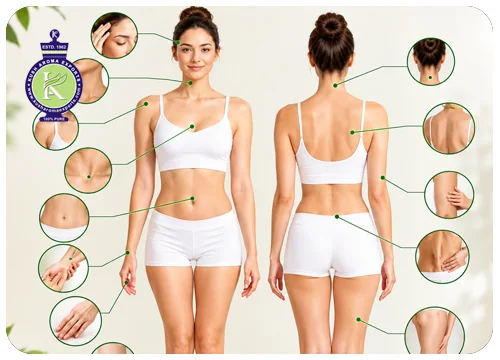
Where to Use Essential Oils on the Body
People often ask where to put a blend. In truth, how to use essential oils on the body depends on the goal. Here is a practical map.
| Goal | Where to apply | Notes |
|---|---|---|
| Calm, sleep | Wrists, back of neck, soles of feet | Diluted roll-on works well |
| Focus | Temples (avoid eyes), wrists | Peppermint or rosemary |
| Tension headache | Temples, forehead edges, neck | Keep well away from the eyes |
| Sore muscles | Directly over the muscle | Massage in a diluted blend |
| Stuffy head | Chest, under the nose (adults only) | Steam works better for most |
| Skin care | The affected area | 1 percent or lower on the face |
For headaches specifically, our post on essential oils for headaches and stress has blends and timings that suit different causes.
How Much and How Often to Use Essential Oils
Beginners tend to use too much. So here is a quick reference on how to use essential oils in the right amounts.
| Method | Amount | How often |
|---|---|---|
| Diffuser (100 ml) | 3 to 5 drops | 30 to 60 min on, 1 hour off |
| Tissue or inhaler | 1 to 2 drops | As needed, short breaths |
| Roll-on (10 ml) | 2 to 4 drops in carrier | 2 to 3 times a day |
| Body massage (30 ml) | 12 drops in carrier | Daily is fine at 2 percent |
| Face (30 ml) | 3 to 6 drops in carrier | Daily, patch test first |
| Steam bowl | 2 to 3 drops | Once or twice a day |
| Bath | 5 to 10 drops in carrier | A few times a week |
A useful rule from the Tisserand Institute: 20 drops is roughly 1 ml. However, drop size varies with the oil and the dropper. For anything you sell, weigh your oils instead.
Common Mistakes When You Use Essential Oils
Most mistakes in how to use essential oils come from a handful of habits. Avoid these and you are already ahead.
- Applying neat oil. Even lavender can sensitise skin over time.
- Diffusing all day. Your nose stops noticing the scent, so you add more. Headaches follow.
- Dropping oil straight into the bath. It floats. Mix it into a carrier first.
- Putting oil near the eyes. If it happens, wipe with a carrier oil, not water. Water spreads it.
- Using citrus oil before sun exposure. Lemon, lime, bergamot and grapefruit can cause a burn-like reaction for up to 18 hours.
- Storing oils in sunlight or heat. Both spoil the oil. Keep bottles in a cool, dark cupboard.
- Swallowing oils. Never do this at home. It is not a wellness tip, it is a poisoning risk.
A Simple Starter Routine to Use Essential Oils Daily
If you want a place to begin, this three-part routine shows how to use essential oils across a full day with just three bottles.
- Morning. One drop of peppermint on a tissue while you get ready. Breathe it for a minute for a clear head.
- Afternoon. A 2 percent lavender and sweet orange roll-on on your wrists when the day gets busy.
- Evening. Diffuse lavender for thirty minutes before bed, then switch it off. Our post on lavender essential oil benefits and uses explains why this oil suits so many uses.
After a week, add one more oil for a specific goal. The essential oils and their uses guide matches oils to needs so you can choose well.
How to Use Essential Oils: FAQs
How do you use essential oils for beginners?
Start with diffusing, the simplest and safest method. Add 3 to 5 drops to a diffuser and run it for 30 to 60 minutes. Next, try a 2 percent roll-on: 4 drops in a 10 ml bottle of carrier oil. Avoid neat skin contact, and never swallow oils.
How do you use lavender oil for sleep?
Diffuse 3 to 5 drops of lavender in the bedroom 30 minutes before bed, then switch it off. Alternatively, place one drop on a tissue tucked into your pillowcase. A 2 percent roll-on on the wrists and the back of the neck also works. Evidence is mixed, but many find it helps a wind-down routine.
Where do you apply essential oils on the body?
Common spots are the wrists, the back of the neck, the temples for headaches, the soles of the feet, and directly over sore muscles. Always dilute first. Keep oils well away from the eyes, and away from the noses of young children.
Can I put essential oils directly on my skin?
No, not as a rule. Undiluted oil can irritate the skin and cause sensitisation, a lasting allergic reaction. Dilute to 2 percent for the body and 1 percent or lower for the face. Patch test any new blend on the inner forearm and wait a day before using it more widely.
How many drops of essential oil should I put in a diffuser?
Three to five drops in a standard 100 ml diffuser suits most rooms. Large rooms may take up to 8. Run it for 30 to 60 minutes, then rest for an hour. More oil does not mean more benefit, and heavy diffusing can cause headaches.
Can I add essential oils straight to my bath?
It is not a good idea. Oils do not mix with water, so they float on the surface and touch your skin neat. Mix 5 to 10 drops into a tablespoon of carrier oil or full-fat milk first, then add that to the bath. Epsom salts alone do not disperse the oil.
The Bottom Line
Learning how to use essential oils comes down to six methods and three rules. Diffuse, inhale, apply diluted, steam, bathe with a carrier, or clean with them. Dilute for skin, keep amounts small, and never swallow.
Start with one method and one oil. Then build from there. Above all, buy oils you can verify, because the best technique in the world cannot fix a poor bottle.
Start with oils you can trust
Every oil in the Kush Aroma range is distilled in-house in Kannauj and comes with a batch-specific Certificate of Analysis on request. Pick your first three and put this guide to work.
About Kush Aroma Exports
Kush Aroma Exports has been distilling essential oils in Kannauj, Uttar Pradesh, India’s historic perfumery capital, since 1962. We steam distil, cold press and CO2-extract at our own ISO-certified facility, so we see these oils from raw plant material through to the finished batch. Our organic range carries independent organic certification.
That hands-on production experience is what informs this guide. Every oil we supply can come with a batch-specific Certificate of Analysis and a GC/MS report (read how GC-MS testing works), and our product pages publish typical constituent profiles with a clear note that batch values vary.
We write about what we can verify. Where the science is uncertain, we say so.
Sources and further reading
- Tisserand Institute — essential oil safety resources — tisserandinstitute.org
- National Center for Complementary and Integrative Health — Aromatherapy — nccih.nih.gov
- NAHA — Essential oil safety information — naha.org