
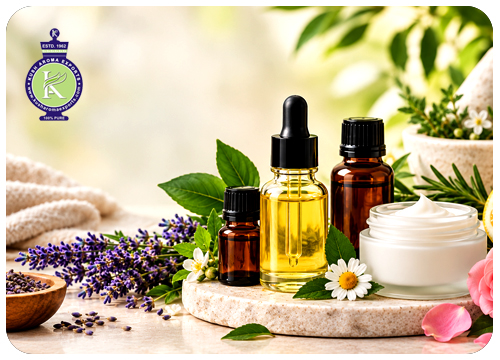
The skincare industry continues to explore botanical ingredients for product development. Essential oils are among the ingredients considered by cosmetic manufacturers, personal care brands, and skincare formulators.
Essential oils in skincare formulations can contribute fragrance, distinctive botanical characteristics, and sensory appeal. However, choosing the right oil involves more than selecting an attractive aroma. Manufacturers must consider ingredient identity, formulation compatibility, stability, safety, and regulatory requirements.
For B2B buyers, consistent quality and reliable sourcing are equally important. The right raw materials help manufacturers maintain product specifications as production grows.
In this guide, we explain how essential oils are used in cosmetic products, how to select suitable ingredients, and what to consider when purchasing bulk essential oils for skincare manufacturing.
Why Are Essential Oils Used in Skincare Formulations?
Essential oils are concentrated aromatic materials obtained from plants. Depending on the botanical species and extraction method, they contain different volatile compounds that influence their aroma and composition. Cosmetic manufacturers may use essential oils for several purposes.
1. Fragrance and sensory appeal
Essential oils can introduce floral, herbal, citrus, fresh, or woody notes into skincare products. For example, lavender offers a herbal-floral profile, while sandalwood is associated with a warm, woody aroma.
These characteristics help brands develop distinctive product identities. They can also support a consistent fragrance theme across cleansers, creams, lotions, and body care products.
2. Botanical ingredient positioning
Many skincare brands highlight plant-derived ingredients in their product ranges. Essential oils may support this positioning when their origin, quality, and intended use align with the brand’s requirements.
However, natural origin does not automatically mean an ingredient is safer. Every essential oil requires appropriate evaluation for its intended application.
3. Product differentiation
A carefully developed fragrance profile can distinguish a premium skincare range from competing products. It may also support a consistent sensory experience across different product formats.
Nevertheless, the fragrance should complement the formula rather than overpower it.
4. Flexible cosmetic applications
Essential oils may be evaluated for face creams, lotions, cleansers, serums, body oils, and other personal care products.
Their suitability depends on the specific oil, product category, concentration, exposure, and formulation system. Therefore, manufacturers should evaluate each ingredient within the complete finished product.
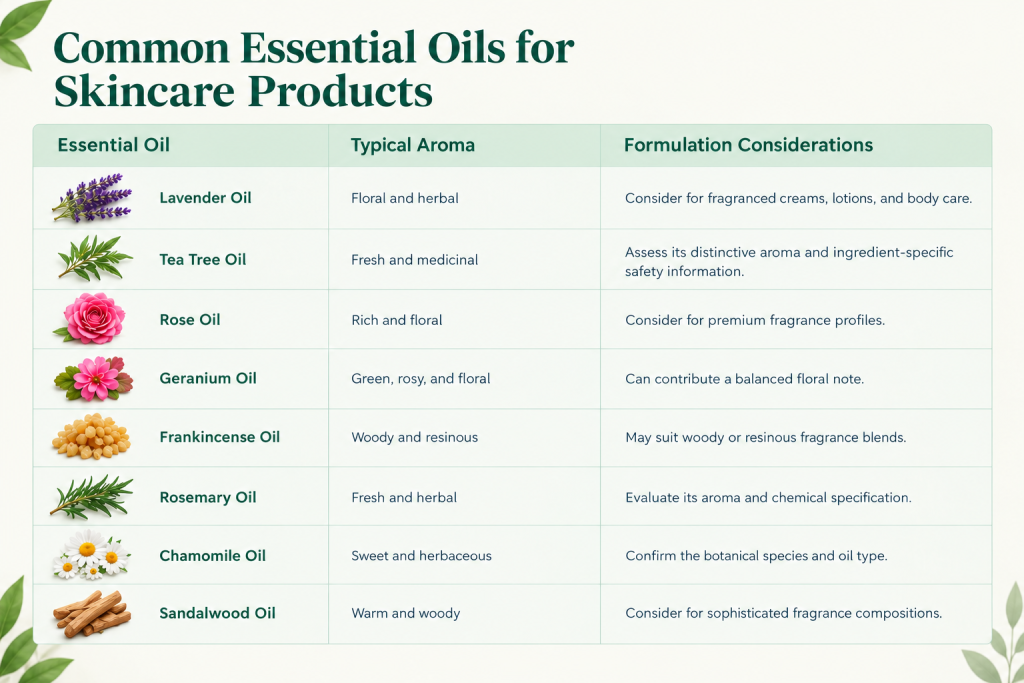
Common Essential Oils for Skincare Products
Essential oils are widely used in skincare products because of their natural aroma, unique properties, and versatility in cosmetic formulations. From facial creams and moisturizers to serums, cleansers, and body lotions, essential oils can add value to different skincare products when selected and formulated correctly.
However, every essential oil has different characteristics. Understanding their properties and suitable applications helps skincare brands and cosmetic manufacturers choose the right ingredients for their formulations.
Let’s explore some of the most commonly used essential oils in skincare products and their applications.
1. Lavender Essential Oil
Lavender essential oil is one of the most popular ingredients in skincare formulations. It is known for its soft floral aroma and is commonly used in creams, lotions, facial oils, and body care products.
Its soothing fragrance makes it a popular choice for relaxation-focused skincare and personal care formulations. Lavender essential oil can be incorporated into facial moisturizers, massage oils, and bath products when used at appropriate concentrations.
2. Tea Tree Essential Oil
Tea tree essential oil is widely used in skincare products designed for oily and acne-prone skin. It has a fresh, medicinal aroma and is commonly included in facial cleansers, spot-care products, soaps, and body washes.
Its antimicrobial properties make it an interesting ingredient for cosmetic formulations targeting blemish-prone skin. However, proper dilution is essential to minimize the risk of skin irritation.
3. Rose Essential Oil
Rose essential oil is valued in premium skincare formulations for its rich floral fragrance and luxurious appeal. It is commonly used in facial serums, creams, moisturizers, and anti-aging cosmetic products.
Rose essential oil is particularly popular in high-end skincare products because of its elegant aroma and association with skin-conditioning formulations. It can also enhance the sensory experience of facial oils and beauty products.
4. Geranium Essential Oil
Geranium essential oil is known for its sweet, floral, and slightly herbal fragrance. It is frequently used in skincare products such as facial oils, body lotions, creams, and moisturizers.
It is a popular ingredient in formulations designed for balanced skincare routines. Geranium essential oil also blends well with floral and citrus essential oils, making it suitable for a variety of cosmetic applications.
5. Frankincense Essential Oil
Frankincense essential oil is a valued ingredient in luxury skincare and personal care products. It has a warm, woody, and slightly spicy aroma that makes it suitable for premium facial oils, creams, serums, and moisturizers.
It is commonly associated with mature-skin and skin-conditioning formulations. Its distinctive fragrance also makes it a popular choice for natural and botanical skincare collections.
6. Rosemary Essential Oil
Rosemary essential oil has a fresh, herbaceous aroma and is commonly used in skincare, haircare, and personal care formulations.
In skincare products, it can be incorporated into facial cleansers, soaps, body washes, and massage oils. Its antioxidant components make it an interesting ingredient for cosmetic formulation research. Formulators should also consider its specific chemotype and skin compatibility when selecting rosemary essential oil.
7. Chamomile Essential Oil
Chamomile essential oil is appreciated for its gentle, soothing fragrance and is commonly used in skincare products formulated for sensitive-skin routines.
It can be incorporated into facial creams, body lotions, massage oils, and other personal care products. Chamomile essential oil is especially popular in calming and comfort-focused cosmetic formulations.
8. Sandalwood Essential Oil
Sandalwood essential oil is known for its warm, rich, and creamy woody fragrance. It is widely used in premium skincare products, including facial oils, creams, moisturizers, soaps, and body care formulations.
Its luxurious aroma makes it a popular ingredient in traditional and modern beauty products. Sandalwood essential oil also blends well with floral, herbal, and woody oils.
How to Select Essential Oils for Cosmetic Formulations
Ingredient selection should follow a clear process. This helps manufacturers balance formulation requirements, product quality, safety, and commercial needs.
1. Define the product category
Start by identifying the product and its intended use.
A facial moisturiser remains on the skin. A cleanser is usually rinsed off. A body lotion may cover a larger area than a facial product.
These differences influence the safety assessment and acceptable ingredient levels. An oil suitable for one product may not be suitable for another.
2. Verify the botanical source
Ask the supplier for the complete botanical name and relevant sourcing details. Also, confirm the extraction method and the plant part used.
These details help distinguish materials that share similar trade names but have different properties.
3. Review purity and composition
Essential oil quality should not be judged by aroma or appearance alone. Request appropriate analytical data and compare the results against a suitable specification.
Depending on the oil, useful information may include a GC-MS report, physical properties, and other relevant test results.
4. Evaluate compatibility
The essential oil must work with the other ingredients in the formula. It may affect fragrance, clarity, colour, or physical stability.
Furthermore, essential oils do not simply dissolve in water. A water-based formula may require a suitable solubiliser or emulsification system.
5. Assess the supplier
A reliable supplier should communicate clearly about product identity, batch traceability, available documentation, packaging, and supply capacity.
For commercial production, evaluate these factors before approving an ingredient for repeated orders.
How Essential Oils Are Used in Different Skincare Formulations
Essential oils may be considered for several types of cosmetic products. However, the formulation determines the appropriate ingredient, incorporation method, and use level.
Essential oils for face cream formulation
Face creams often combine water, oils, emulsifiers, moisturising ingredients, and other functional materials.
An essential oil may contribute fragrance or a distinctive sensory profile. Before selecting one, formulators should assess facial exposure, potential irritation, allergen content, and suitability for the intended user group.
Products designed for sensitive skin require especially careful ingredient selection and substantiated claims.
Essential oils for lotion formulation
Body lotions are commonly emulsions designed for application across larger skin areas.
The selected oil must remain compatible with the emulsion and the product’s fragrance requirements. During development, check for changes in odour, colour, texture, and physical stability.
The complete formula must also undergo an appropriate safety assessment.
Essential oils for facial serum formulation
Facial serums can be water-based, oil-based, or emulsion-based. Each format creates different compatibility requirements.
In an oil-based serum, the formulator should assess compatibility with the carrier oils. In a water-based serum, a suitable solubilisation system may be necessary.
Do not assume that adding an essential oil directly to a serum will produce a stable and uniform product.
Essential oils for cleanser formulation
Facial cleansers, body washes, and similar products may contain surfactants and other cleansing ingredients.
Essential oils can influence fragrance, clarity, and overall product behaviour. Therefore, test the finished formula for stability, performance, and packaging compatibility.
Essential oils for body care products
Body butters, massage products, shower products, and body lotions may incorporate essential oils for fragrance.
However, manufacturers must consider the application area, exposure, product type, and relevant safety requirements before selecting an oil.
Essential oils for natural skincare brands
Brands developing botanical skincare ranges should evaluate ingredient quality alongside marketing considerations.
Traceability, reliable specifications, appropriate labelling, and substantiated claims can help support a consistent brand proposition. These factors become particularly important when moving from small batches to commercial production.
How to Incorporate Essential Oils into Skincare Products
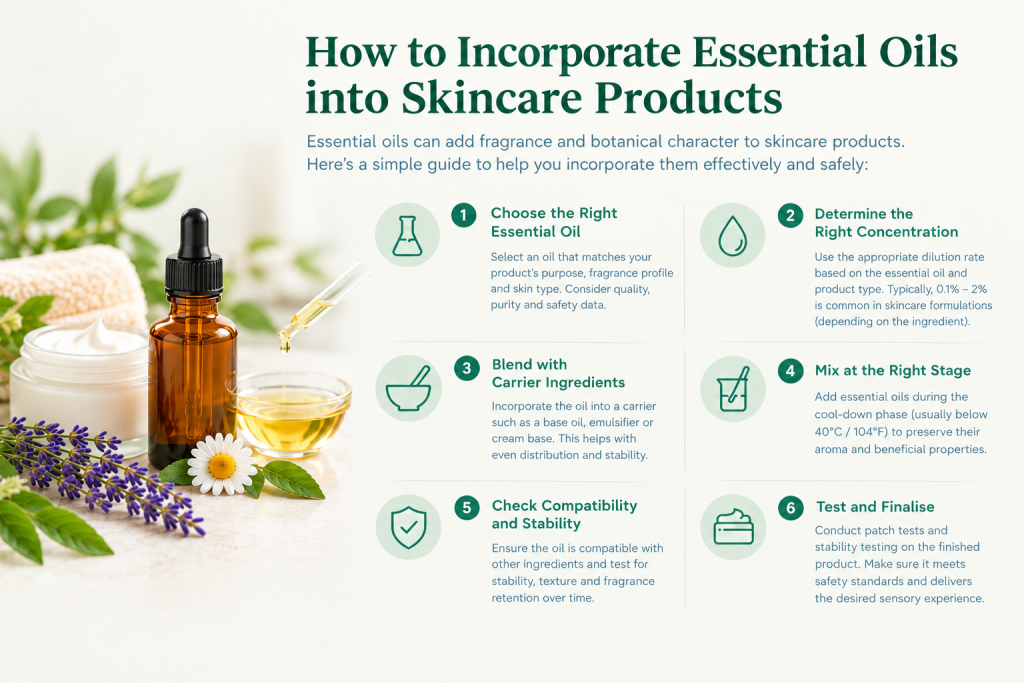
There is no single incorporation method suitable for every essential oil. The correct approach depends on the oil, base formulation, processing conditions, and manufacturing equipment.
Step 1: Review the complete formula
Identify the product category, ingredients, manufacturing process, and target market. Review any safety concerns or restrictions before starting laboratory trials.
Step 2: Establish the appropriate use level
Determine the proposed concentration using the relevant safety assessment, supplier information, current standards, and applicable regulations.
Avoid applying one generic dilution percentage to every essential oil. Different oils have different compositions and may have different restrictions.
Step 3: Choose the incorporation method
Some ingredients may be added during a suitable cooling stage. Others may require pre-blending or a validated addition process.
Follow the formulation protocol and supplier guidance. Do not assume that the same processing temperature or mixing method will work for every ingredient.
Step 4: Ensure uniform distribution
Use a compatible solubiliser, emulsifier, or mixing process when required. Confirm that the oil distributes consistently throughout the batch.
Poor dispersion can create uneven fragrance and affect the finished product’s quality.
Step 5: Test the finished formula
Evaluate the product for appearance, odour, pH where applicable, physical stability, packaging compatibility, and other relevant quality parameters.
A qualified safety assessment and appropriate testing should support commercial release.
Step 6: Document the process
Record the ingredient supplier, lot number, quantity, process conditions, and test results. Maintain traceability between raw-material documents and finished-product batches.
This becomes increasingly important when a product moves from laboratory development to large-scale manufacturing.
Essential Oil Safety in Cosmetics
Safety is essential when working with concentrated aromatic ingredients. Some essential oils or their constituents may cause irritation, sensitisation, or other adverse effects under certain conditions.
The US Food and Drug Administration explains that plant-derived ingredients are not automatically safe. Cosmetic companies remain responsible for product safety and appropriate labelling. Read the FDA’s guidance on aromatherapy and essential oils.
Check concentration and intended use
The appropriate concentration depends on the specific oil, its composition, the product category, and exposure.
Where relevant, review the current IFRA Standards and guidance for the intended application. These standards can help manage fragrance-related risks, but they do not replace the manufacturer’s overall safety assessment or applicable local regulations. See IFRA’s explanation of its Standards.
Review allergen information
Some essential oils naturally contain constituents that may cause allergic reactions in susceptible users.
Review the relevant ingredient documentation and determine whether allergen disclosure or other precautions apply in the destination market.
Do not assume that a low concentration eliminates every potential risk.
Check phototoxicity concerns
Certain citrus oils may create phototoxicity concerns, depending on their identity and processing method. This matters particularly for products applied to skin that may be exposed to sunlight.
Confirm the exact oil, relevant composition data, and any applicable restrictions before approving its use.
Avoid unsupported claims
Cosmetic marketing claims should match the product’s intended use and available evidence.
Avoid presenting a cosmetic essential oil as a treatment for acne, eczema, infection, or another disease without appropriate scientific and regulatory review.
Claims can affect product classification in some markets. Manufacturers should check the rules applicable to every destination where they plan to sell.
Conduct appropriate product testing
Depending on the product, a development programme may include:
- Stability testing under suitable conditions.
- Packaging compatibility testing.
- Microbiological quality assessment.
- Preservative efficacy testing where relevant.
- Safety assessment of the finished formula.
- Additional testing when justified by the product and intended use.
Raw-material documents are important, but they do not replace finished-product evaluation.
Essential Oil Quality Testing: GC-MS, CoA and Batch Consistency
Quality documentation helps manufacturers assess whether an ingredient meets their specifications. It also supports traceability and repeatable production.
What does a GC-MS report show?
Gas chromatography–mass spectrometry (GC-MS) helps characterise the volatile components of an essential oil.
The resulting profile can be compared with suitable reference information and the buyer’s specification. This can support identity and quality assessment.
However, a GC-MS report does not automatically prove that an oil is pure, safe, or free from every possible adulterant. Results must be interpreted in context and may need support from additional tests.
Why is a Certificate of Analysis important?
A Certificate of Analysis (CoA) records test results for a particular batch against defined parameters.
Depending on the product, it may include identity-related information, physical properties, chemical parameters, or other relevant measurements.
Buyers should confirm that the CoA corresponds to the supplied batch. They should also verify that the reported results meet their own acceptance criteria.
Why does batch consistency matter?
Botanical source, harvest conditions, storage, and processing can influence an essential oil’s composition and aroma.
For skincare manufacturers, variation may affect fragrance, product quality, and repeatability. A clear raw-material specification helps procurement teams assess future deliveries against the same requirements.
What documents should buyers request?
Depending on the ingredient and intended market, useful documents may include:
- Certificate of Analysis.
- GC-MS report or chromatographic profile.
- Safety Data Sheet.
- Botanical identity and origin details.
- Batch or lot identification.
- Storage and shelf-life recommendations.
- Relevant allergen information.
- Applicable technical or regulatory documentation.
Kush Aroma Exports provides information about its essential oil range and GC-MS resources. Explore the essential oils catalogue and GC-MS information page to begin evaluating products for your requirements.
Confirm the documents available for the specific oil and batch before placing an order.
Buying Essential Oils in Bulk for Skincare Manufacturing
Bulk sourcing involves more than comparing prices per kilogram. Manufacturers also need reliable specifications, suitable packaging, consistent quality, and dependable supply.
Evaluate quality and traceability
Share your required botanical identity, specification, intended use, and documentation needs with the supplier.
Ask how the supplier identifies each batch and maintains its quality records. Where appropriate, request a sample for internal evaluation before committing to a larger order.
Confirm supply capacity and lead times
Discuss available quantities, minimum order requirements, typical lead times, and packaging formats.
This is particularly important when your production depends on a specific botanical source or fragrance profile.
Review packaging and storage
Essential oils may be sensitive to oxygen, light, temperature, or other storage conditions.
Suitable packaging and handling can help maintain quality during storage and transport. Follow product-specific storage guidance rather than assuming every essential oil has the same shelf life.
Compare the total sourcing value
A lower unit price does not always mean a lower total cost.
Consider documentation, quality consistency, packaging, delivery, communication, and the risk of rejected batches. A reliable sourcing process can be valuable for long-term manufacturing.
How to Choose an Essential Oils Supplier for Cosmetics
Choosing a suitable supplier is an important step for cosmetic manufacturers and skincare brands.
Use this checklist when evaluating potential partners.
- Product identity: Can the supplier confirm botanical names and product details?
- Quality documents: Are relevant CoAs and analytical reports available?
- Traceability: Can each supplied batch be linked to its documentation?
- Supply capacity: Can the supplier support your order volume and lead times?
- Communication: Can the team answer procurement and technical questions clearly?
- Export requirements: Can the supplier discuss packaging and documents needed for your destination market?
- Specification alignment: Can you evaluate the material against your approved requirements?
- Long-term suitability: Can the supplier support repeat orders against the same agreed specification?
Before approving a supplier, review samples and documents against your internal quality requirements.
Kush Aroma Exports offers an essential oil range for buyers evaluating ingredients for cosmetic and personal care applications. Visit the Kush Aroma Exports website to explore its offerings and discuss your sourcing needs.
Conclusion: Source Essential Oils with Quality and Confidence
Essential oils can contribute distinctive aromatic profiles to skincare and personal care products. However, successful formulation requires careful ingredient selection, appropriate incorporation methods, safety assessment, and quality testing.
For cosmetic manufacturers, a reliable sourcing process matters just as much. Batch traceability, clear specifications, and suitable documentation help support consistent commercial production.
Kush Aroma Exports works with buyers seeking essential oils for cosmetic and personal care applications. Explore the product range, review the available quality information, and discuss your requirements before selecting ingredients for your next formulation.
Frequently Asked Questions
No. Suitability depends on the specific oil, product format, concentration, exposure, and safety assessment. Each finished formula should be evaluated before commercial release.
Lavender, tea tree, rose, geranium, frankincense, rosemary, chamomile, and sandalwood are examples used in cosmetic ingredient research. The appropriate choice depends on the desired aroma, formula compatibility, safety data, and product specification.
Manufacturers may review batch-specific GC-MS profiles, Certificates of Analysis, botanical details, and relevant physical or chemical test results. Additional testing may be appropriate based on the ingredient and the buyer’s quality requirements.
No. Natural origin does not guarantee safety. Some essential oils and their constituents can irritate skin, cause sensitisation, or present other risks. The finished product requires an appropriate safety assessment.
Buyers should request botanical identity, product specifications, available batch documentation, storage recommendations, packaging details, and supply information. They should confirm that the documents match their intended application and market.


No Comments